Credit Utilization Explained: How It Affects Your Credit Score
Credit Utilization Explained
If you’ve ever wondered why your credit score dropped after making a large purchase, credit utilization is often the reason.
Credit utilization is one of the biggest factors affecting your credit score. Even if you never miss a payment, using too much of your available credit can lower your score.
The good news is that it’s also one of the easiest parts of your credit score to improve.
In this guide, you’ll learn what credit utilization is, how it’s calculated, what percentage you should aim for, and practical ways to keep it low.
What Is Credit Utilization?
Credit utilization is the percentage of your available revolving credit that you’re currently using.
In simple terms, it answers one question:
How much of your available credit have you used?
Lenders view this percentage as a sign of financial responsibility. Using a small portion of your available credit generally shows that you’re managing your accounts well. Using most of your available credit can signal financial stress, even if you make every payment on time.
Credit utilization only applies to revolving credit accounts such as:
- Credit cards
- Store credit cards
- Personal lines of credit
- Home equity lines of credit (HELOCs)
Installment loans like mortgages, auto loans, and personal loans are not included in your credit utilization ratio.
How Is Credit Utilization Calculated?
The formula is simple:
Credit Utilization = Current Balance ÷ Total Credit Limit × 100
Here’s an example.
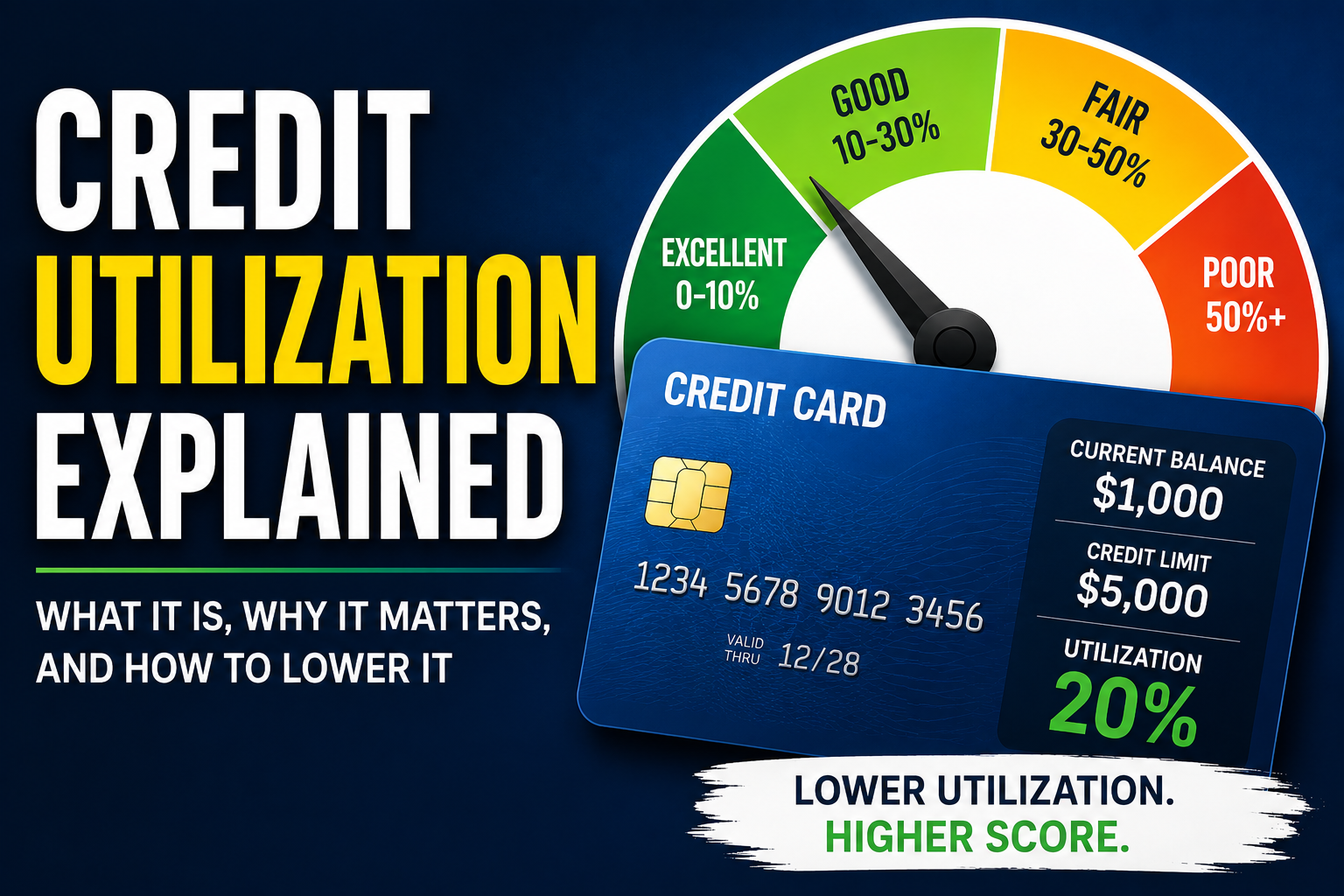
Suppose you have one credit card with:
- Credit limit: $5,000
- Current balance: $1,000
Your utilization would be:
$1,000 ÷ $5,000 = 20%
Now imagine you have three credit cards.
| Credit Card | Balance | Credit Limit |
|---|---|---|
| Card 1 | $500 | $2,000 |
| Card 2 | $1,000 | $5,000 |
| Card 3 | $250 | $3,000 |
Your total balance is $1,750.
Your total credit limit is $10,000.
Your utilization ratio is:
$1,750 ÷ $10,000 = 17.5%
This is considered healthy.
Why Does Credit Utilization Matter?
Credit utilization is one of the largest components of your credit score.
While payment history carries the most weight, utilization is typically the second most important factor.
High utilization may indicate that you’re relying heavily on borrowed money, making lenders view you as a higher-risk borrower.
Even if you’ve never missed a payment, a high utilization ratio can lower your score.
What Is a Good Credit Utilization Ratio?
There isn’t one perfect number, but these general guidelines can help.
| Utilization | Impact |
| Under 10% | Excellent |
| 10% to 30% | Good |
| 30% to 50% | Fair |
| Over 50% | Poor |
| Near 100% | Very High Risk |
Many people have heard the advice to keep utilization below 30%.
While that’s a good rule of thumb, many people with excellent credit keep their utilization below 10% most of the time.
Remember that lower is generally better, as long as you’re using your credit cards responsibly.
Individual Card Utilization vs. Overall Utilization
Many people focus only on their total utilization.
That’s a mistake.
Credit scoring models often look at both:
- Your overall utilization across all credit cards
- The utilization on each individual card
For example:
You have three cards.
Each has a $5,000 limit.
One card has a $4,500 balance.
The other two have zero balances.
Your overall utilization is only 30%.
However, one card is using 90% of its available credit.
That high balance may still hurt your score.
It’s a good idea to keep both your overall utilization and each individual card’s utilization as low as possible.
How Often Is Credit Utilization Updated?
Most credit card companies report your balance to the credit bureaus once each month.
This usually happens shortly after your statement closes, not when your payment is due.
That means your score may temporarily decrease if your reported balance is high, even if you pay the bill in full a few weeks later.
Knowing your statement closing date can help you manage what gets reported.
How to Lower Your Credit Utilization
Improving your utilization ratio doesn’t have to be complicated.
Pay Your Balance Before the Statement Closing Date
Many people wait until the payment due date.
Instead, consider paying part or all of your balance before the statement closes.
A lower balance is more likely to be reported to the credit bureaus.
Make Multiple Payments Each Month
If you use your card frequently, making two or three payments throughout the month can keep your reported balance low.
Ask for a Credit Limit Increase
If your income has increased and you’ve been making payments on time, your credit card issuer may approve a higher credit limit.
A higher limit can reduce your utilization ratio without changing your spending.
Avoid increasing spending just because your limit increases.
Spread Purchases Across Multiple Cards
Instead of placing every purchase on one card, distribute spending across multiple cards when appropriate.
This can help reduce high utilization on any single account.
Pay Down High-Interest Debt First
Reducing large balances not only improves utilization but may also save money on interest.
Common Credit Utilization Mistakes
Avoid these common mistakes.
Maxing out a credit card
Using nearly all of your available credit can significantly lower your score.
Closing old credit cards
Closing a card reduces your available credit, which may increase your utilization ratio.
Only making minimum payments
Balances may stay high for years, keeping utilization elevated.
Applying for unnecessary new credit
Opening new accounts solely to increase available credit isn’t always the best strategy and may result in hard inquiries.
Does Paying Off Your Credit Card Immediately Raise Your Score?
It can.
Once your credit card issuer reports your new lower balance, your utilization ratio may improve, which can help your credit score.
The exact increase depends on your overall credit profile and other factors in your credit history.
Recommended Tools
If you’re working to improve your credit, these tools can make the process easier.
- Credit monitoring services to track score changes and receive alerts.
- Identity theft protection services to monitor your personal information.
- A monthly budgeting app to help control spending.
- A simple document organizer or fireproof safe for storing financial records.
- A cross-cut paper shredder to securely dispose of sensitive documents.
Verdict: Keep Balances Low
Credit utilization is one of the quickest parts of your credit score that you can improve.
By keeping your balances low, paying before your statement closes, and avoiding high utilization on individual cards, you can strengthen your credit profile over time.
Small changes today can make a meaningful difference when you’re applying for a mortgage, financing a car, or qualifying for a new credit card.
Frequently Asked Questions
What is the best credit utilization percentage?
Many financial experts recommend keeping your utilization below 30%, but staying below 10% is often associated with the highest credit scores.
Does paying my credit card twice a month help?
It can. Making multiple payments throughout the month may keep your reported balance lower, improving your utilization ratio.
Is 50% credit utilization bad?
A 50% utilization ratio is generally considered high and may negatively affect your credit score.
Does carrying a balance improve my credit score?
No. Carrying a balance from month to month does not improve your credit score and can result in unnecessary interest charges.
How quickly can lowering my utilization improve my credit score?
Because most card issuers report balances monthly, you may see improvements after your updated lower balance is reported to the credit bureaus.